
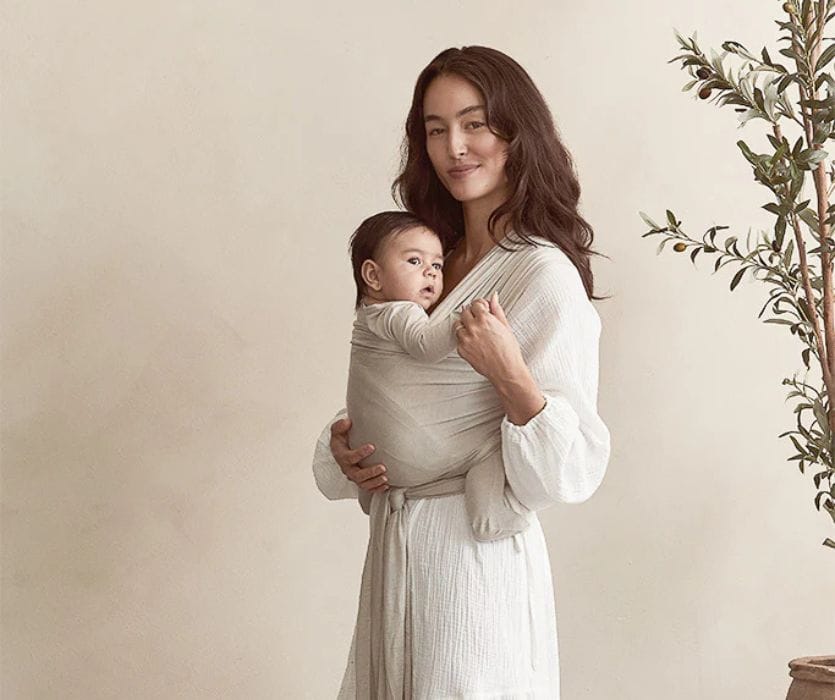
If soft structured carriers are the workhorse of babywearing, stretchy wraps are the warm hug of the newborn stage. They're snuggly, forgiving, and remarkably good at soothing a baby who just wants to be held. Many parents describe them as the thing that got them through the first few months with their sanity intact.
They also have a natural end of life, and knowing that going in saves a lot of frustration later. Here's everything you need to know.
What you'll find here:
- What a stretchy wrap actually is
- How to wear your baby in one
- Age and size range (and why it matters)
- Honest pros and cons
- Hybrid options for those who want something simpler
- How to know if this is the right type for you
- Brands worth knowing about
What Is a Stretchy Wrap?
A stretchy wrap is a long piece of knit fabric – usually around 16 feet (5 meters) – that you tie around yourself and your baby. Knit fabric stretches in all directions, which is what gives stretchy wraps their signature soft, mold-to-your-body feel. Different brands have more or less stretch, but they all belong to the same family.
Most stretchy wraps are one-size-fits-most, which means the same wrap works for wearers of different sizes – a genuine advantage when you're sleep-deprived and don't want to think about fit.
You've probably heard of Solly Baby, Boba Wrap, and Moby. Those are all stretchy wraps.
How Do You Wear Your Baby in One?
Stretchy wraps require three layers of fabric over your baby, which provides the structure and support. The most common carry is called a Pocket Wrap Cross Carry (PWCC) — most brands include this in their instructions under their own name, like "hug hold."
The positions available in a stretchy wrap are more limited than other carrier types. Most work best for:
Front carry, facing in — The primary position and the one you'll use most. Baby faces your chest, knees higher than bottom, supported snugly against you.
Front carry, facing out — Technically possible but generally not recommended. The three-layer construction makes it difficult to achieve a safe, supportive position for an outward-facing carry. If forward facing is important to you, a different carrier type will serve you better.
Stretchy wraps are not suitable for back carries.
What Age and Size Can Use One?
Most stretchy wraps are rated from around 8 lbs up to 25–35 lbs. In practice, most parents find them comfortable and supportive up to around 15 lbs – not because they become unsafe after that, but because the stretch that makes them so lovely for newborns starts working against you as your baby gets heavier. The fabric can feel saggy and unsupportive, and getting a tight enough wrap becomes increasingly difficult.
For most babies this means a stretchy wrap works beautifully from birth through roughly 3–4 months, then it's time to transition to something more structured. That's not a failure – it's exactly what they're designed for.
The Honest Pros and Cons
What stretchy wraps do really well:
They're genuinely great for newborns. The soft, stretchy fabric molds around a tiny baby in a way buckle carriers simply can't replicate. Many newborns who resist other carriers settle immediately in a stretchy wrap.
They can be pre-tied. You tie the wrap around yourself before you leave the house, then pop baby in and out as needed without re-wrapping in a parking lot. This is a bigger deal than it sounds.
They're affordable. Most stretchy wraps fall in the $30–$75 range, making them one of the lowest-cost entry points into babywearing.
One size fits most. The same wrap works for different wearers, which makes sharing easy.
Where they fall short:
There's a learning curve. Tying a stretchy wrap correctly takes practice. Most parents need several tries before it feels natural (and doing it in a parking lot or public place adds another layer of challenge). The good news is it clicks fairly quickly.
Three layers means more warmth. In hot or humid climates, three layers of fabric around you and your baby adds up. Lighter fabrics help, but there's no getting around the fact that this is a warmer carry than a ring sling or a single-panel carrier.
Limited positions. No back carries, limited hip carry options, and forward facing isn't practical. If you want versatility, you'll need to add another carrier type eventually.
Shorter lifespan. Once your baby approaches 15 lbs, it's probably time to transition. For a fast-growing baby, that might be sooner than you expect.
What About Hybrid Options?
If the idea of learning to wrap feels daunting, hybrid options exist that try to give you the feel of a stretchy wrap with less actual wrapping. Two types come up most often:
Simplified stretchy hybrids — These are stretchy wraps that have been pre-cut and partially sewn into loops, vests, or pockets to reduce the amount of wrapping required. The Moby Easy Wrap and Baby K'tan fall into this category. They're easier to get on but come with their own tradeoffs — the K'tan is sized (meaning you and your partner can't share one), and neither offers significantly more longevity than a standard stretchy wrap.
Performance hybrids — These are made from material that behaves similarly to a stretchy wrap but offers more support and versatility. The Wrapsody Hybrid Wrap, for example, can be used for back carries — something a standard stretchy wrap can't do. The Didymos Doubleface is another option in this category. These are worth knowing about if you want something that bridges the gap between a stretchy wrap and a woven wrap.
Is a Stretchy Wrap Right for You?
Go for it if:
- You have a newborn or are expecting one soon
- You want something soft and snuggly for the early weeks
- Budget is a consideration
- You're comfortable with a short learning curve
- You live in a mild climate or plan to use it primarily indoors
Maybe look elsewhere if:
- Your baby is already over 15 lbs
- You live somewhere very hot and humid
- You want one carrier to last from birth through toddlerhood
- Back carries are important to you
Brands Worth Knowing About
Solly Baby One of the most popular stretchy wraps for the newborn stage. Lightweight modal fabric that's softer and thinner than most competitors — genuinely lovely in warmer weather. Worth noting: the length means it can drag on the ground when you're putting it on in public, which some parents find frustrating. You can find them on the Solly Baby site.
Boba Wrap A reliable, widely available option at an accessible price point. Many parents find it has slightly more stretch than the Solly, which some prefer for a snugger feel. Good first wrap if you want something easy to find and easy to return if it doesn't work for you. You can find them on Boba.com.
Moby Wrap One of the originals and still widely recommended. Similar feel to the Boba. The Moby Easy Wrap (their hybrid version) reduces the wrapping steps if you want something simpler, though you lose some of the versatility of the original. Check them out on the Moby site.
Baby K'tan Pre-sewn loops make it faster to put on than a traditional stretchy wrap — no tying required. The tradeoff is that it's sized, meaning you and your partner likely need different sizes. Worth considering if ease of use is the top priority and sharing isn't a concern. Find them on the Baby K'tan site.
A Note on Heat
Stretchy wraps come up constantly in discussions about hot weather babywearing, usually as something to avoid in high heat. Three layers of fabric is three layers of fabric regardless of the material. If you're in a genuinely hot, humid climate, a ring sling or a single-layer carrier in linen or cotton will be more comfortable for both of you. That said, many parents in warm climates use stretchy wraps successfully indoors or in air conditioning during the newborn stage — just go in with realistic expectations.
Before You Buy
As with any carrier, try before you buy if you can. Stretchy wraps are one of the more forgiving types to buy secondhand since they're fabric with no hardware to wear out. Just check for thinning, pilling, or loss of stretch before purchasing used.
If you buy one and struggle with the technique, don't give up before watching a few videos or getting a fit check. The learning curve is real but short — most parents feel confident within a week of regular practice.
The Full Series
- Overwhelmed by Baby Carriers? Here's Where to Actually Start
- The Beginner's Guide to Soft Structured Carriers
- Ring Slings: What They Are, How They Work, and Why Parents Love Them
- Beyond the Buckle: A Guide to Woven Wraps and Meh Dais
- What Is an Onbuhimo? Everything You Need to Know About This Underrated Carrier
- Just Tell Me Which Carrier to Buy: A Practical Guide for Overwhelmed Parents
This post may contain affiliate links. If you purchase through my links I may earn a small commission at no extra cost to you. Thanks for supporting Pregnant Chicken — it keeps the lights on and supports our free content. Updated February 2026.
Leave a Comment